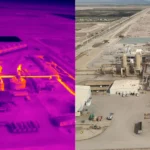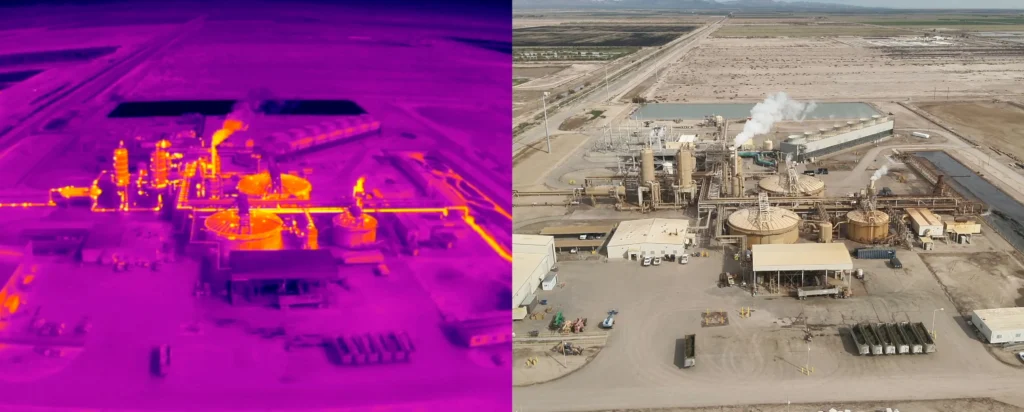
Anyone can point a thermal camera at a structure and come back with orange and purple pictures.
Far fewer can say what those colours mean. That difference decides who gets paid for inspection work, and it is exactly what thermal drone inspection training addresses.
Capture is easy. Interpretation is the job.
A thermal sensor records temperature difference. It does not identify faults.
A bright spot on a solar panel might be a failed bypass diode, a cracked cell, soiling, or simply a reflection. A warm patch on a tower connector might indicate resistance, or it might indicate afternoon sun on one side of the steel.
Getting that wrong carries cost in both directions. Report a false fault and a crew mobilises for nothing. Miss a real one and the client finds out when the asset fails.
Consequently, employers screen hard for interpretation. They assume you can fly.
What the discipline actually involves
Thermal inspection rests on physics that most pilots never learn.
Emissivity. Different materials radiate heat differently. A polished metal surface and a painted one at the same temperature will not look the same on screen.
Reflection. Thermal cameras see reflected infrared as well as emitted. Sky reflection on a flat surface misleads constantly.
Load conditions. An electrical fault often shows only under load. Inspecting a solar array at low irradiance, or a transformer at low demand, can hide the very thing you were sent to find.
Ambient and time of day. Solar loading changes everything. The same asset inspected at 8am and 2pm produces different images and different conclusions.
Delta measurement. Severity usually depends on temperature difference against a reference, not on absolute temperature.
None of that is visible from flying ability.
Where the demand sits
Thermal inspection drives a large share of commercial drone work in Nigeria.
Power utilities inspect transmission lines, towers and substations for hot connections. Solar operators scan arrays for underperforming modules. Oil and gas operators assess insulation, process equipment and flare structures.
Telecom operators check power systems and connections at base stations. Industrial facilities inspect motors, bearings, switchgear and roofing.
Every one of those missions needs someone who can tell a finding from an artefact.
What the training covers
Our specialist module builds on commercial certification rather than replacing it.
- Infrared theory — emissivity, reflection, transmission and atmospheric effects
- Camera setup — palettes, range, span, level and when each matters
- Flight technique for thermal — angle, distance, speed and coverage patterns
- Condition selection — load state, time of day, weather and what invalidates a survey
- Fault pattern recognition across electrical, mechanical and structural assets
- Severity classification and prioritised reporting
- Deliverable standards — what a client expects in an inspection report
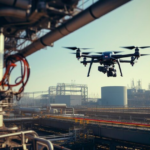
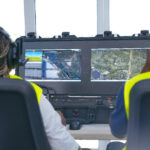
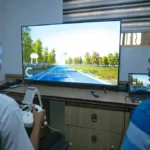
Practical sessions use enterprise thermal payloads rather than demonstration equipment.
Why train with us
ARCO Aviation Academy is Nigeria’s first NCAA-licensed drone training institution, and we sit inside ARCO Worldwide.
Our instructors fly thermal inspection commercially across oil and gas, power, telecom and solar assets, under ISO 9001:2015 certified processes. So the interpretation you learn is the interpretation clients are currently paying for.
You also train on the platforms the industry deploys, because we supply them as Nigeria’s DJI Enterprise Solutions Partner.
Specialists do not compete on price
A general pilot competes with everyone holding the same certificate. A thermal inspection specialist competes with far fewer, for work that cannot be done without the skill.
If you hold a commercial licence and want the next step, this is one of the shortest routes to higher-value missions.
Ready to specialise? Enrol in thermal inspection training with ARCO Aviation Academy today.