The Shot Nobody Got Because Nobody Was Certified to Fly It
A stadium flyover. A crowd shot that makes a local match feel like a continental final. A perimeter watched closely enough that nothing unauthorised gets near it. Somebody has to fly that mission, and increasingly, production companies and event organisers are finding out the hard way that “somebody with a drone” isn’t the same thing as somebody certified to fly one legally, safely, and well.
That gap is exactly where aerial cinematography training Nigeria offers is opening real career doors right now, and the timing couldn’t be better.
A Season Built on Aerial Content
Nigeria’s football season runs on more than match results. Viewing centres fill every weekend. Brand activations, fan festivals, and sponsor events build around the calendar’s biggest fixtures. Every one of those moments gets filmed, streamed, or promoted, and increasingly, the footage that stands out is shot from the air.
At the same time, stadium and event security has become its own specialised skill. A rogue drone disrupted a Premier League match between Brentford and Fulham last season, pausing play at Gtech Community Stadium in front of thousands of fans. Nigeria’s own football events are scaling toward that same size, and the operators watching their skies need to be just as capable.
Two Careers, One Certification Path
Aerial cinematography and event security work look different on the surface, but they start from the same place. Both require certified pilots who understand airspace regulation, flight safety, and how to operate cleanly around crowds, cameras, and other aircraft sharing the same sky.
VLOS certification builds that foundation. It’s the entry point for pilots aiming at photography, filming, and event coverage work, missions flown within direct line of sight, close to the action, exactly where a stadium flyover or crowd shot happens. Pilots aiming at security and perimeter monitoring typically move further, into BVLOS training, which prepares them to fly longer, wider-reaching missions that a single security post could never cover on foot.
What Training Actually Looks Like at ARCO Aviation Academy
At ARCO Aviation Academy, the VLOS course runs 15 days and needs no prior aviation background. It covers airspace regulations, flight theory, and the hands-on flying skill that separates a professional shot from an amateur one. For pilots moving into security and long-range work, BVLOS training follows with 7 additional days of advanced mission planning and command-and-control systems.
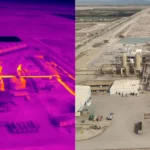
Instructors bring real operational weight to this training. As active ARCO Worldwide Services operators, they’ve flown the exact kind of missions this career path leads to, cinema-grade aerial imaging for productions and broadcasters, and perimeter security using thermal-equipped platforms built for exactly that job. Students train on scenarios drawn from real missions, not theoretical exercises built for a classroom.
Where This Certification Actually Leads
Graduates don’t just leave with a licence to fly. They leave connected to ARCO Worldwide Services, an operator actively delivering aerial cinematography and event security work across Nigeria’s biggest productions and gatherings.
That connection matters more than it might seem. A certificate proves you can fly legally. A direct line into an operator already doing this work professionally is what turns that certificate into an actual career.
The Next Shot, Covered
Somewhere this season, another stadium moment will need someone certified to capture it properly, or watch over it responsibly. The pilots ready for that call are the ones who trained for it before the moment arrived.
Ready to be one of them? Apply to ARCO Aviation Academy today.